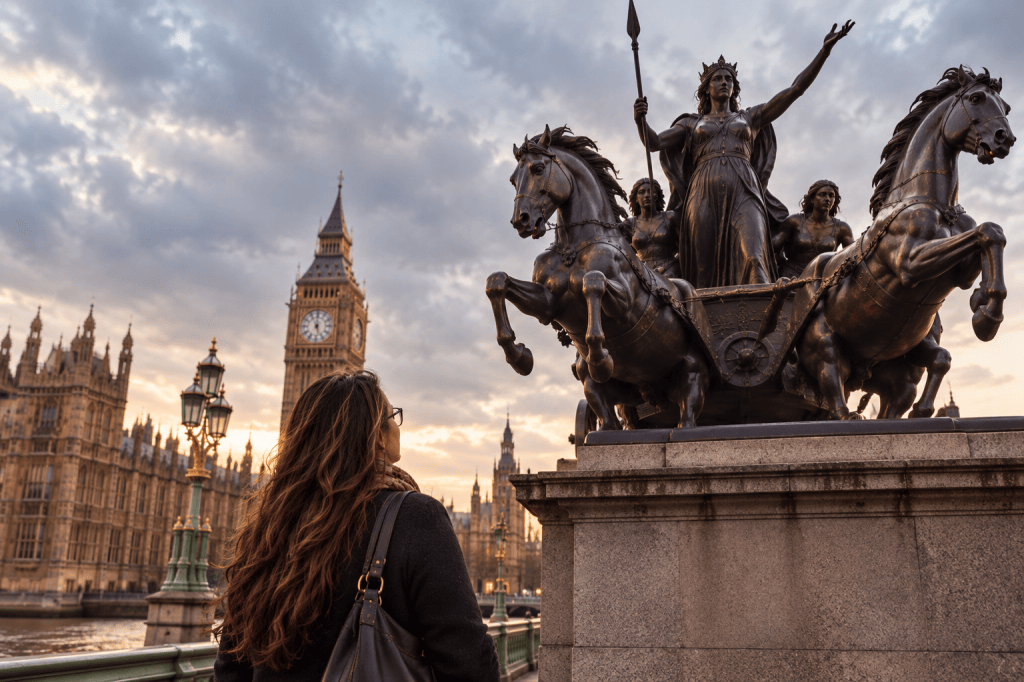
Nearly twenty years ago, I stood before a monument in London and wondered why an ancient warrior queen had been given such a commanding place in the British landscape. I did not know then that the question would eventually become the foundation of my doctoral research.
Nearly twenty years ago, I encountered Boudica for the first time. Not in a Roman text, a history classroom, or an academic article, but in bronze.
Standing near Westminster, I found myself looking up at an enormous statue of a woman charging forward in a chariot, her daughters beside her and horses rearing dramatically before them. The location itself seemed to demand attention. Here, within sight of Parliament and some of the most recognizable symbols of British political power, this ancient woman had been made monumental.
I remember wondering who she was, but almost immediately another question followed: Why was she here?
There are thousands of years of British history and countless figures who might have been immortalized in such a prominent place. Yet here stood a woman from the first century, a queen who had led a devastating rebellion against Roman rule, represented not simply as a historical figure but as something powerful, heroic, and unmistakably British.
At the time, I had no idea that I had stumbled onto a question that would follow me for nearly two decades.
Who Was Boudica?
Before Boudica became a statue, a national symbol, or the subject of my dissertation, she was a woman living through the Roman conquest of Britain.
Rome’s invasion of Britain began under the emperor Claudius in AD 43, but Roman control over the island was neither immediate nor complete. Britain was inhabited by numerous peoples with their own political structures and relationships with Rome. Among them were the Iceni of eastern Britain.
Boudica was the wife of Prasutagus, king of the Iceni. Prasutagus appears to have ruled as a client king, maintaining a degree of local authority while accommodating Roman power. According to Tacitus, when Prasutagus died, he attempted to protect his kingdom and family by naming both the Roman emperor and his daughters as heirs.
It did not work.
Tacitus describes a brutal aftermath. The kingdom was treated as though it had been conquered outright. Boudica was flogged, and her daughters were raped. Members of the Iceni elite were stripped of property, while the political arrangement that had existed under Prasutagus collapsed.
Whatever Rome expected to happen next, the result was rebellion.
Around AD 60 or 61, while the Roman governor Gaius Suetonius Paulinus was campaigning elsewhere in Britain, Boudica emerged at the head of an uprising. The Iceni were joined by other Britons with grievances against Roman rule, most notably the Trinovantes.
Their first major target was Camulodunum, modern Colchester, a Roman colony and a potent symbol of occupation. The settlement was destroyed. Boudica’s forces then moved toward Londinium, the developing commercial settlement that would become London. Suetonius, unable to defend it with the forces available to him, abandoned the city. Londinium was burned.
Verulamium, near modern St Albans, followed.
Roman and Romanized settlements had been devastated, and ancient accounts describe enormous loss of life. The rebellion had become a genuine threat to Roman control of the province.
Eventually, however, Suetonius assembled his forces and confronted Boudica’s much larger army. Despite being heavily outnumbered according to our ancient sources, the disciplined Roman army defeated the Britons. Tacitus reports that Boudica subsequently took poison, while Cassius Dio’s later account says that she became ill and died.
Then Boudica disappears from the historical record.
That should, perhaps, have been the end of her story.
It wasn’t.
The Problem of Knowing Boudica
One of the reasons Boudica fascinates me is that the woman herself remains remarkably difficult to reach.
She left us no writings. We have no surviving Iceni account of the rebellion and no words that can confidently be identified as Boudica’s own. Even the famous speeches attributed to her come through Roman authors using the literary conventions of ancient historical writing.
Our principal narratives come from Tacitus and Cassius Dio, Roman men writing within the culture against which Boudica had rebelled. Tacitus was much closer chronologically to the revolt and had a family connection to Roman Britain through his father-in-law, Agricola. Cassius Dio wrote considerably later. Their accounts differ in significant ways, including in how they describe Boudica herself.
Both authors were also doing more than simply recording events. Ancient historians wrote with literary, moral, and political purposes. Their Boudica therefore comes to us already mediated through Roman ideas about gender, power, imperial rule, civilization, disorder, and the dangers and possibilities represented by powerful women.
That creates a remarkable historical problem. One of the most recognizable women of ancient Britain survives almost entirely through the words of the people whose empire she tried to overthrow.
We do not have Boudica telling us who she was.
We have people remembering, interpreting, and constructing Boudica.
That distinction eventually became central to my research.
From Rebel to British Heroine
There is another strange element to Boudica’s story: for centuries after the Roman accounts, she was hardly the omnipresent national figure suggested by her modern monument.
Her cultural importance had to be constructed.
As ancient texts were recovered, translated, circulated, and reinterpreted in later Britain, Boudica became available to new generations of writers, historians, artists, antiquarians, politicians, and eventually the wider public. Each encountered an ancient figure who could be adapted to contemporary concerns.
That adaptation created some extraordinary contradictions.
Boudica could represent resistance to foreign occupation, but she could also be incorporated into the historical imagination of a Britain that possessed an empire of its own. She could be praised for courage and patriotism while simultaneously challenging assumptions about women’s proper relationship to political and military power.
She could be a grieving mother defending her daughters, a dangerous barbarian threatening civilization, a warrior queen defending her people, a patriotic ancestor, or a symbol of female resistance.
Eventually, she could stand in bronze near Parliament itself.
The historical woman had not changed.
What changed were the societies remembering her and the things they needed her to represent.
A Peculiar Kind of Reverence
Over the years, my connection to Britain became much more personal. I married into a British family and spent more time around British culture, stories, traditions, and ways of talking about the past.
I began noticing something I would later learn to describe much more precisely: certain historical figures occupy a space somewhere between history and cultural mythology. People do not simply know about them. These figures seem to carry meanings that extend beyond the details of their individual lives.
Boudica was one of those figures.
That fascinated me because her place in British memory is anything but straightforward. She fought against an occupying empire, yet centuries later she could be embraced by a nation at the center of an enormous empire of its own. She belonged to the Iceni, yet later memory could transform her into a representative of Britain itself. She could be described through the language of barbarism in one period and celebrated as a national heroine in another.
The more I noticed these contradictions, the more interesting that monument became.
Why Boudica? Why this woman? Why had she survived in cultural memory when so many others had not? And why had so many different generations found something useful in her?
I did not yet have the language to describe exactly what interested me.
Eventually, I found it: cultural memory.
Where History Meets Psychology and Sociology
During one of my doctoral seminar courses, I had the opportunity to explore cultural memory more seriously, and I was fascinated almost immediately.
History has always been my academic home, but my background and teaching have also kept me deeply interested in psychology and sociology. Cultural memory sits at a particularly compelling intersection of those disciplines because it allows us to ask questions not only about what happened, but about what human beings and societies subsequently do with what happened.
How do societies remember their pasts? Why are certain events commemorated while others fade? Why do communities build monuments to particular people? How do stories about historical figures change as cultural values change? What happens when memory becomes entangled with gender, politics, nationalism, or identity?
Most importantly, cultural memory reminds us that societies do not simply receive the past intact.
They continually reconstruct it.
A monument is therefore more than a decoration. A historical novel is more than entertainment. A painting, political speech, schoolbook, television portrayal, commemorative ceremony, or statue can become part of the process through which a society decides what the past means.
That realization changed the way I thought about history.
Theodora—and Boudica Returns
Interestingly, my first substantial exploration of these questions did not begin with Boudica.
It began with Theodora, the sixth-century Byzantine empress and wife of Justinian I.
I became interested in the ways Theodora had been constructed and reconstructed through historical writing and later cultural imagination. Like Boudica, she was a powerful woman whose historical reputation had been filtered through male authors and through changing assumptions about gender, sexuality, political authority, and appropriate female behavior.
The more I worked with Theodora, the more fascinated I became with the larger methodological question. I found myself less interested in simply determining whether a particular later portrayal was “accurate” and increasingly interested in asking why that portrayal existed in the first place.
What did it tell us about the people who created it?
What did they need this woman from the past to mean?
And somewhere in that exploration, Boudica appeared again.
The woman in the chariot had found me a second time.
This time, however, I had a completely different set of questions to ask.
From “Who Was She?” to “What Did She Become?”
The question I had first asked in London—Who was Boudica?—was no longer enough.
I wanted to know what happened to her after her historical life ended.
The Boudica we encounter in Tacitus is not precisely the same Boudica we encounter in Cassius Dio. Neither is necessarily the same woman imagined by later British writers. Those representations, in turn, change as Britain itself changes.
A Boudica remembered in an age concerned with monarchy and female rule can mean one thing. A Boudica imagined during the height of the British Empire can mean another. A Boudica invoked in discussions of feminism, nationalism, colonialism, resistance, or modern British identity can become something else again.
That does not make these later Boudicas historically meaningless.
Quite the opposite.
They become evidence of how later societies understood themselves.
That is the point at which my curiosity about an ancient queen became a dissertation about cultural memory.
Why Boudica?
My doctoral research traces the cultural memory of Boudica from Roman antiquity through modern Britain, examining how representations of her have changed alongside ideas about gender, national identity, empire, and historical memory.
There are theoretical frameworks behind that question. There is historiography. There are primary sources, monuments, texts, images, and eventually more footnotes than I care to contemplate.
But underneath all of it remains the same curiosity that began nearly twenty years ago.
I can still picture that monument: Boudica standing in her chariot with her daughters beside her, placed prominently within the landscape of British national power.
I did not know enough then to recognize all the contradictions contained within that image. Here was a woman who fought Rome but whose story survives through Roman authors; an Iceni queen transformed into a British national heroine; a rebel against empire who would later be commemorated by an imperial nation; and a woman whose own voice has been lost but whose imagined voice has been repeatedly recreated by others.
Most fascinating of all, nearly every generation that encounters her seems capable of discovering a different Boudica.
That is why I study her.
I am interested in the woman who lived and rebelled in the first century, but I am equally fascinated by the nearly two thousand years of people who came afterward and continued to reconstruct her. Their Boudicas can tell us about gender and power, about empire and resistance, about national identity, and about the complicated ways societies use the past to understand the present.
The question that began for me in front of a monument was never completely answered.
Instead, over the years, it became a better question:
Why have we needed Boudica to be so many different things?
Nearly twenty years after I first stood beneath that bronze warrior queen and wondered why she was there, I am still trying to answer it.
Only now, it has a dissertation attached to it.


Leave a comment