What a classroom conversation about memory reminded me about teaching students to question evidence
Today in my psychology class, we were talking about memory.
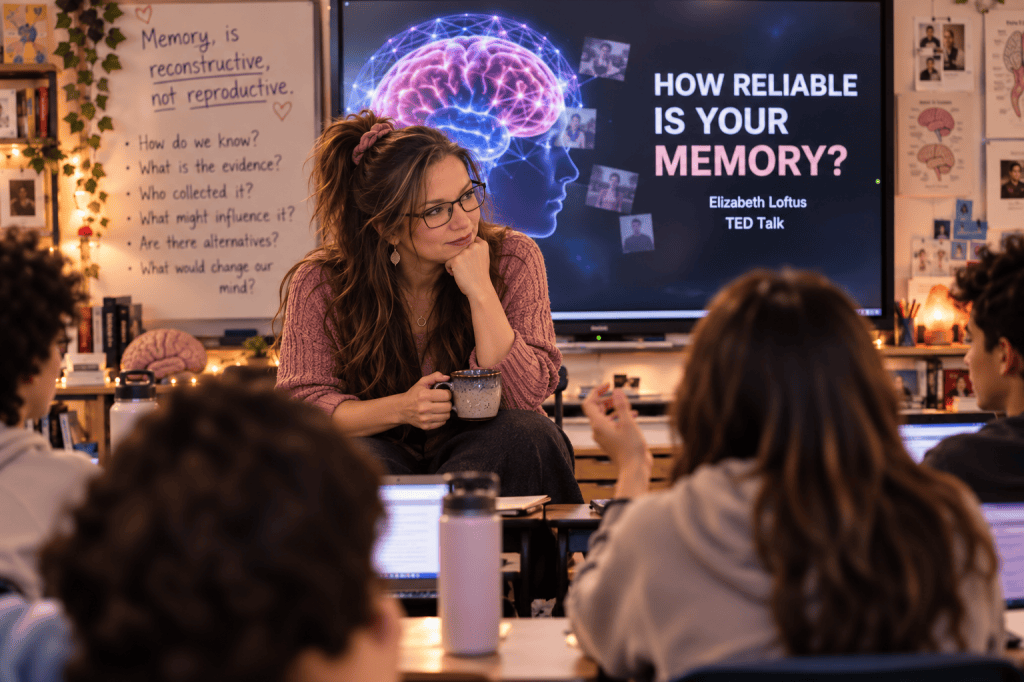
We were watching Elizabeth Loftus’s TED Talk on the reliability of human memory, particularly her work demonstrating that memory is not the perfectly preserved recording of our experiences that we sometimes imagine it to be. Memories can be altered. The way a question is asked can affect what someone remembers, and people can sometimes remember details—or even experiences—that did not happen in quite the way they recall them.
The conversation began where I expected it to. We talked about eyewitness testimony, wrongful convictions, and the consequences that can follow when people place too much confidence in memory. The TED Talk uses the case of Steve Titus, who was wrongfully convicted after an eyewitness identification, to demonstrate just how serious those consequences can become. 1 – AP Psychology- How Reliable…
Then the students started doing what I love most: they began making connections.
Several immediately thought about arguments they had experienced with friends or family members. Two people can be absolutely convinced that they remember the same conversation correctly, yet remember it differently. One person remembers exactly what was said while someone else is equally certain that those words were never spoken. Both may genuinely believe their version.
Suddenly, memory wasn’t just something psychologists studied in laboratories. It was something that had happened at the dinner table, in an argument with a parent, or during a disagreement between friends. It was the certainty of I know what you said colliding with someone else’s equally sincere certainty that that is not what happened.
The psychology had become personal.
Memory Is Everywhere
That led us into a broader discussion about just how many areas of our lives depend upon memory.
The obvious example is criminal justice. Eyewitness testimony can influence investigations, trials, and ultimately someone’s freedom. Loftus’s work has helped demonstrate why confidence in a memory does not necessarily guarantee its accuracy and why the wording of questions matters when witnesses are interviewed. In one of the examples discussed in the TED Talk, changing a word used to describe a simulated car accident influenced participants’ estimates of speed and even whether they later remembered seeing broken glass that had never been present. 1 – AP Psychology- How Reliable…
But memory matters far beyond a courtroom. It affects relationships and education. It influences the stories families tell about themselves. It contributes to how individuals understand their own experiences and identities.
It also shapes how groups and societies understand the past, and that is where today’s psychology lesson began bumping into another part of my academic life: history.
The Question Underneath the Lesson
One of the questions I find myself asking students constantly, regardless of the subject I am teaching, is deceptively simple:
How do we know?
A claim can sound convincing. Someone can believe it sincerely. A source can appear authoritative, and a memory can feel extraordinarily vivid. None of those things automatically makes the claim accurate.
So we start asking questions. What is the evidence? Where did it come from? How was it collected? Who produced it? What factors might have influenced it? Does other evidence support it? Is there another reasonable interpretation?
Those questions belong in a psychology classroom, but they also belong in sociology and history. In fact, historians spend an enormous amount of time asking versions of exactly the same question.
From Elizabeth Loftus to Boudica
This connection is particularly difficult for me to miss right now because I spend part of my day teaching students about evidence and memory and another part working on a dissertation about cultural memory.
My dissertation examines the ways Boudica has been remembered and reconstructed over time. Even at the very beginning of that story, I face a problem remarkably similar to the one I ask my students to confront: How do we know?
Boudica did not leave us an autobiography. We do not have her diary, letters, or an Iceni account of the revolt. Much of what we know about her comes through Roman writers, particularly Tacitus and Cassius Dio. That does not mean we simply open Tacitus, read what he wrote, and declare the mystery solved.
Instead, we have to interrogate the source. Who was Tacitus? When was he writing? What relationship did he have to the events he described? What sources might have been available to him? What literary conventions influenced the way Roman historians wrote? What assumptions about women, political power, Romans, and Britons shaped the world in which his account was produced?
Then we compare his account with other surviving evidence and ask what we can reasonably conclude. The specific methods used by a psychologist and a historian are different, of course, but beneath them is a shared intellectual habit: evidence must be examined rather than simply accepted.
Certainty Is Not the Same as Accuracy
That may have been the most interesting part of today’s conversation. My students recognized immediately how certain people can be about their memories because they had experienced it themselves.
Most of us have.
We have been completely convinced that something happened one way only to discover that someone else remembers it differently. Sometimes there is evidence that settles the disagreement; sometimes there isn’t. That creates an uncomfortable possibility: sincerity and accuracy are not necessarily the same thing. Someone can tell the truth as they genuinely remember it and still be mistaken.
For students, that realization matters far beyond a unit on memory. We live in an environment saturated with claims, and students encounter them through social media, videos, advertisements, news, friends, family members, teachers, artificial intelligence, and countless other sources.
The challenge is no longer simply gaining access to information. It is learning what to do with it.
Teaching the Question
There are plenty of things I need my students to learn. In psychology, there are theories, studies, vocabulary, biological processes, and concepts they need to understand. In sociology, there are perspectives and patterns they need to recognize. When I teach history, there are people, events, contexts, and arguments they need to know.
Increasingly, though, I think one of the most valuable things I can teach them is a habit of mind. When they encounter a confident claim, I want there to be a tiny voice somewhere in the back of their minds asking:
How do we know?
I don’t want them to ask because everything should be distrusted, because evidence is meaningless, or because every interpretation is equally valid. Quite the opposite. I want them to ask because evidence matters.
I want them to understand that strong conclusions require strong evidence, that sources need context, and that certainty is not proof. I also want them to understand that changing a conclusion when better evidence appears is not weakness; it is intellectual honesty.
Today, that lesson began with Elizabeth Loftus and a conversation about memory. Then my students started talking about arguments with their parents and friends, and somewhere between eyewitness testimony and “No, I KNOW that’s what you said,” the larger lesson emerged.
Years from now, most of my students probably will not remember every term I taught them in psychology. They may forget the names of individual studies or exactly which concept appeared on which test, and that’s okay.
There is one question I hope they remember:
How do we know?
Because once a student learns to ask that question—and genuinely cares about finding the answer—we have taught them something much larger than the material on the test.


Leave a comment