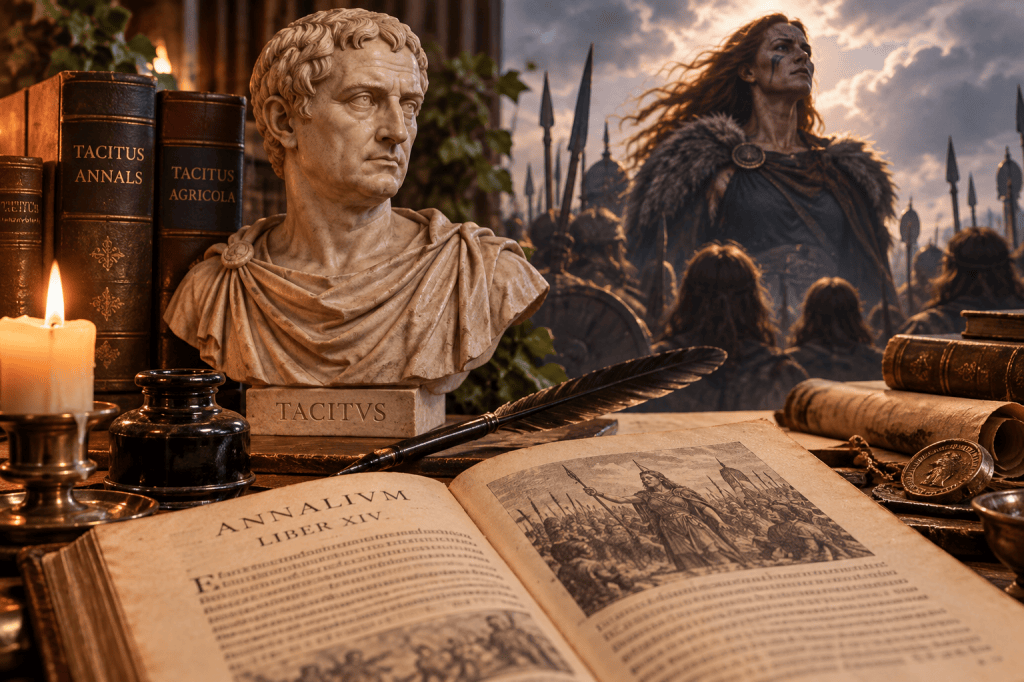
What happens when one of our most important sources for Boudica is also part of the problem?
In my psychology classroom, I regularly ask my students a deceptively simple question: How do we know? It is the question underneath almost every conversation about evidence. Who is making the claim? What evidence supports it? How was that evidence produced? What might have influenced it, and what conclusions can we reasonably draw from it?
When I leave the classroom and return to my dissertation, I find myself asking exactly the same questions.
For anyone trying to understand Boudica and the revolt of AD 60/61, one of our most important sources is the Roman historian Tacitus. Without him, much of what we think we know about Boudica would disappear. He tells us about the treatment of Boudica and her daughters after the death of her husband, Prasutagus. He describes the grievances that helped ignite the rebellion, the destruction of Roman settlements, the Roman military response, and Boudica’s eventual defeat.
Tacitus even gives Boudica a voice. The problem, of course, is that Tacitus was not Boudica. He was not standing beside her as she addressed her army. He was not an eyewitness to the revolt, and he was writing decades after it occurred. He was a Roman senator and historian writing about a woman who had led a rebellion against Roman rule.
So when we read Tacitus, what exactly are we reading? That question sits at the heart of what historians do with primary sources.
Who Was Tacitus?
Publius Cornelius Tacitus was a Roman senator, politician, and historian whose writings provide some of our most important accounts of the early Roman Empire. His surviving works include the Agricola, Germania, Histories, and Annals. For the story of Boudica, two of those works are particularly important: the Agricola and the Annals.
Tacitus also had an intriguing connection to Roman Britain. His father-in-law was Gnaeus Julius Agricola, who served in Britain during the Roman conquest and later became governor of the province. Tacitus eventually wrote a biography of him, the Agricola.
That connection makes Tacitus particularly valuable. Agricola had firsthand experience in Britain and served there during the period in which the Boudican revolt occurred, meaning Tacitus may have had access to information originating with people much closer to the events than he was.
Access to potentially valuable information, however, is not the same thing as providing an objective transcript of the past. Tacitus was still making choices. He decided which events to include, which details mattered, how individuals would be portrayed, and how the story would be organized. Like other ancient historians, he was constructing a narrative as well as preserving information about the past.
That means the historian’s task cannot end with asking what Tacitus says. We also have to ask why he says it that way.
When Boudica Speaks
This becomes particularly important when we encounter one of the most compelling parts of Tacitus’s narrative: Boudica’s speech before battle.
The image is irresistible. A warrior queen stands before a force of Britons preparing to confront Rome. She speaks about liberty, injustice, resistance, and the wrongs committed against herself and her daughters before urging her people to fight.
It is also unlikely that Tacitus was providing his readers with anything resembling a word-for-word transcript of Boudica’s speech.
Speeches were a familiar feature of ancient historical writing. Historians could use them to dramatize events, explain motivations, construct opposing viewpoints, and explore political or moral themes. A speech attributed to a historical figure therefore cannot automatically be treated as a record of the exact words that person spoke.
That does not make Boudica’s speech useless as historical evidence. It changes the questions we ask of it.
Instead of limiting ourselves to “Did Boudica really say these exact words?”, we can ask what Tacitus accomplishes by giving her these particular words. What kind of Boudica does he create? What does her speech allow him to say about Roman power, liberty, tyranny, gender, or the relationship between Rome and the people it conquered?
The speech therefore becomes evidence in a different way. It may tell us less about Boudica’s exact words than we would like, but it can tell us quite a lot about how a Roman historian chose to represent her.
For my dissertation, that distinction matters enormously.
A Roman Writing About Rome’s Enemy
It would be tempting to assume that because Tacitus was Roman, his account simply presents Rome as the hero and Boudica as the barbarian enemy. His writing is considerably more complicated than that.
Tacitus could be deeply critical of Roman political life, corruption, tyranny, and abuses of power. That makes his treatment of Boudica particularly interesting because the rebellion gives him an opportunity to show what can happen when imperial authority becomes abusive.
His description of the events preceding the revolt illustrates this tension. The violence inflicted upon Boudica and her daughters and the treatment of the Iceni are not incidental details. They help establish a narrative in which Roman behavior itself contributes to the catastrophe that follows. Boudica may be Rome’s enemy, but her grievances can simultaneously expose Roman failures.
At the same time, she is still being constructed through Roman categories and literary conventions. Her gender matters. Her status as a Briton matters. Roman ideas about civilization and barbarism matter, just as the political and moral concerns of Tacitus’s own world matter.
When we read his account, then, we are not looking through a perfectly clear window onto Boudica. We are looking through Tacitus’s window, and the shape of that window affects what we can see.
And Then There Is Cassius Dio
The problem becomes even more interesting when another Roman historian enters the conversation.
Cassius Dio also wrote about Boudica, but he did so considerably later than Tacitus. His account shares important elements with Tacitus’s narrative while differing from it in striking ways, particularly in his description and characterization of Boudica.
Dio gives us a dramatic physical portrait of her. His Boudica is formidable, commanding, and visually extraordinary. She becomes an imposing presence within the narrative in ways that are not identical to the Boudica we encounter in Tacitus.
That difference immediately raises another historical problem. If two ancient authors describe the same woman differently, which Boudica should we trust?
At first, that can seem like a puzzle historians need to solve. If we compare the accounts carefully enough, perhaps we can determine which author is “right” and reconstruct the real Boudica hiding somewhere behind the texts. There is certainly value in that work. Historians do try to determine what can reasonably be reconstructed about past people and events by comparing surviving evidence.
For someone studying cultural memory, however, the differences themselves become interesting.
Tacitus constructed a Boudica, and Cassius Dio constructed another. Later writers would construct still more. The variation between them is not simply an obstacle standing between us and the historical woman; it is also part of the history of her memory.
So, Can We Trust Tacitus?
The answer depends on what we mean by trust.
If trusting Tacitus means assuming that everything he describes happened exactly as he describes it, then we are asking the source to do something no responsible historian should ask of it. But rejecting Tacitus simply because he was Roman, because he wrote after the revolt, or because he used the literary conventions of ancient historiography would be equally problematic. Without his work, we would lose enormously valuable evidence about Roman Britain and the Boudican rebellion.
The better approach is neither blind trust nor automatic distrust. It is critical reading.
We ask when Tacitus was writing and for whom. We consider his political and literary context. We compare his accounts with other surviving evidence. We distinguish between what his work may allow us to say about events in first-century Britain and what it can tell us about Roman historical writing and Roman understandings of those events.
Most importantly, we remain conscious of the distance between Boudica the historical woman and Boudica as she survives in the text.
That distance can be frustrating if our only goal is to recover the woman herself. For my research, however, that distance is precisely where things become interesting.
Reading the Space Between Them
When I first became interested in Boudica, I wanted to know who she was. Nearly twenty years later, I still do. But I have become equally interested in all the people who have answered that question for her.
Tacitus was among the first. Cassius Dio followed, and then came centuries of historians, poets, artists, antiquarians, politicians, novelists, filmmakers, activists, and others who encountered Boudica and constructed their own versions of her.
Each inherited something from the versions that came before. Each also lived within a different cultural moment and brought different assumptions about women, power, Britain, empire, resistance, and identity to the act of remembering her.
That is why I no longer approach Tacitus simply by asking whether I can trust him. I ask what he knew, what he could have known, what he chose to tell his readers, and what kind of Boudica emerged from those choices. Then I ask what happened when later generations encountered that Boudica and began reshaping her again.
There is almost certainly a historical woman somewhere behind all of those layers. My job as a historian is to get as close to her as the evidence will allow without pretending that the gaps in that evidence do not exist.
My work as a historian of cultural memory asks me to do something else as well: pay attention to the layers themselves.
Because the ways people remember, reconstruct, and repurpose the past eventually become part of its history too.


Leave a comment