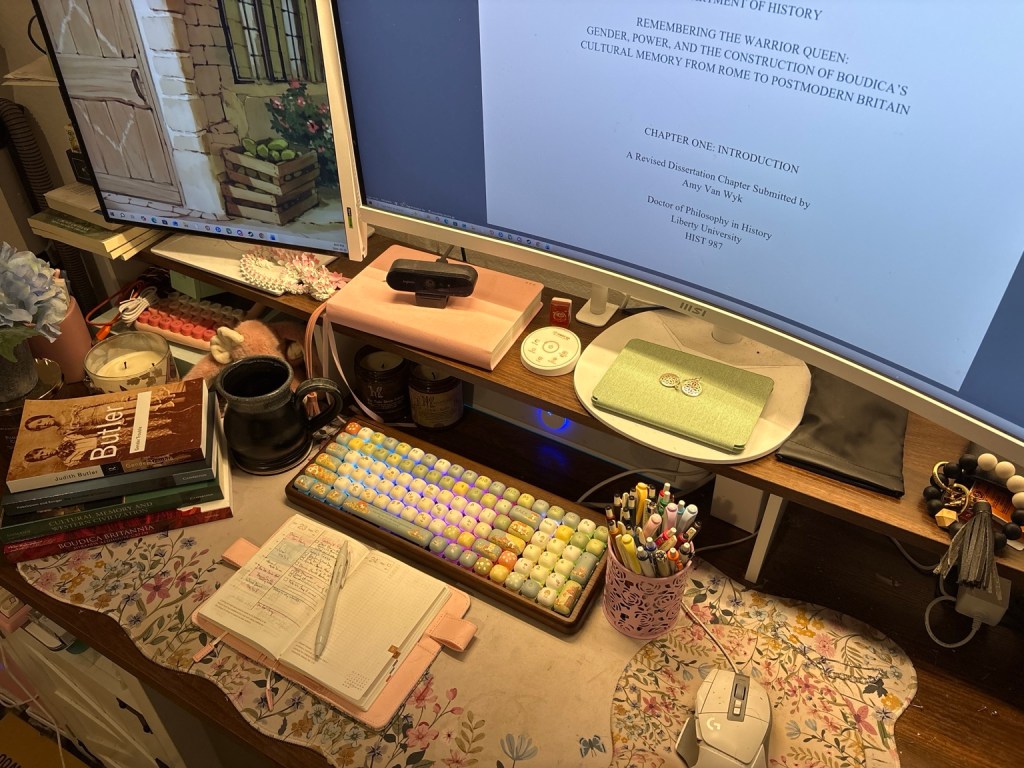
September 28, 2026 · Becoming Dr. Van Wyk
There is something mildly ridiculous about spending years working toward a Ph.D. and still being surprised when someone finally expects you to write a dissertation. And yet, here we are. I am officially in Dissertation I, and that sentence still feels a little strange to write.
For so long, the Ph.D. existed as a series of smaller things that needed to be survived. There was always another class, another paper, another stack of books, another historiography, another exam. Then there were comprehensive exams, which deserve their own category of academic absurdity. There is nothing quite like spending weeks reading everything you can get your hands on, taking thousands of words of notes, and then sitting down to prove that somewhere inside your exhausted brain you have, in fact, become a historian.
I made it through all of that. And suddenly there wasn’t another class waiting for me. There was the dissertation.
Enter Boudica
Fortunately—or perhaps unfortunately, depending on how many footnotes I’ve dealt with on any particular day—I already knew who I wanted to spend the next year thinking about: Boudica.
The warrior queen who led a rebellion against Rome in Britain in AD 60–61 has been dead for nearly two thousand years, and people are still arguing about what she means. That is precisely why I find her fascinating. My dissertation isn’t really about reconstructing the rebellion itself. Plenty of historians have studied that. I’m interested in what happened to Boudica afterward: how Roman writers constructed her, how later generations rediscovered her, why the Victorians turned her into a national heroine, and what happens when a woman who violently resisted an empire becomes a symbol of the very nation that would later build one.
That’s where cultural memory comes in. Somewhere along the way, what began as an interest in one ancient woman became a much larger project about gender, power, resistance, national identity, and the ways societies continually reconstruct the past to serve the present.
So, you know. A nice little manageable dissertation topic.
The Part Nobody Puts in the Brochure
I’m also discovering that doctoral progress doesn’t always look particularly impressive from the outside. Sometimes it does. You finish an exam, submit a chapter, or discover a source that changes the way you’ve been thinking about an argument. Those are the satisfying moments—the ones where you can point at something and say, Look! I did a Ph.D. thing!
Other times, you spend hours reading and taking notes so that you can add one paragraph to a chapter. Then adding that paragraph means changing a footnote, which affects another footnote, and suddenly you’re staring at approximately a hundred footnotes wondering which series of life choices brought you here.
This is apparently also scholarship.
I’m learning that writing a dissertation isn’t simply about knowing enough history. It’s also about learning how to manage an enormous intellectual project without allowing the enormity of it to paralyze you. Some days I’m better at that than others. I’m also doing all of this while teaching full time, so my days can move rather abruptly from teenagers learning psychology and sociology to evenings spent thinking about Roman historiography, British memory, gender theory, and a warrior queen who has somehow taken up permanent residence in my brain.
It’s exhausting. It’s occasionally ridiculous. And I really, genuinely love it.
Why I’m Writing This
That’s really why I wanted to create this space. The finished dissertation will eventually sit neatly on a shelf—or, more realistically, in a university database—and look very orderly. It will have chapters and footnotes and a bibliography and all the appropriate academic machinery. What it won’t show is what it took to make it.
It won’t show the books stacked beside the bed, the notes scribbled into a planner between teaching classes, or the paragraph that somehow took six hours to write. It won’t capture the days when I am completely overwhelmed by the size of the project, nor the moments when an argument suddenly clicks and I remember exactly why I wanted to become a historian in the first place.
And I think those things are worth remembering.
I don’t know exactly what the next year will look like. There will be chapters and revisions, advisor comments, books, deadlines, and an absolutely unreasonable number of footnotes. Eventually, if everything goes according to plan, there will be a completed dissertation and a defense. Somewhere on the other side of all of that, there will be Dr. Amy Michelle Van Wyk.
But I don’t want to remember only the finish line. I want to remember what it took to get there—the ridiculous parts, the difficult parts, the breakthroughs, the failures, and all the ordinary days in between.
So this is where I’m keeping the record.
Becoming Dr. Van Wyk starts here.


Leave a comment